Tag: wwii

  • Occupation bunkers to feature in TV series

    Occupation bunkers to feature in TV series

    A NEW TV series featuring Guernsey’s bunkers is set to air this autumn.

    Secret Nazi Bases will look at the remnants of Nazi schemes, that are hidden across the world and examines the conspiracies surrounding them.

    Among the sites looked at are a number of local fortifications.

    VisitGuernsey, along with Festung Guernsey, the Guernsey Armouries and the Guernsey Military Co, worked with the documentary producers when the crew were on-island in November 2018 and May 2019, providing access to a range of bunkers and defences. While some of the areas featured are open to the public, others are privately owned.

    Filming locations included some of Guernsey’s iconic bunkers, such as MP4 and MP3 observations towers at Pleinmont, as well as the largest bunker complex in the Channel Islands – the German Military Underground Hospital in St Andrew’s. Fully restored bunkers such as the German Naval Signals HQ in St Peter Port, Batterie Scharnhorst, Batterie Mirus and Batterie Dolmen, amongst others, were also featured.

    Go Button Media produced the documentary.
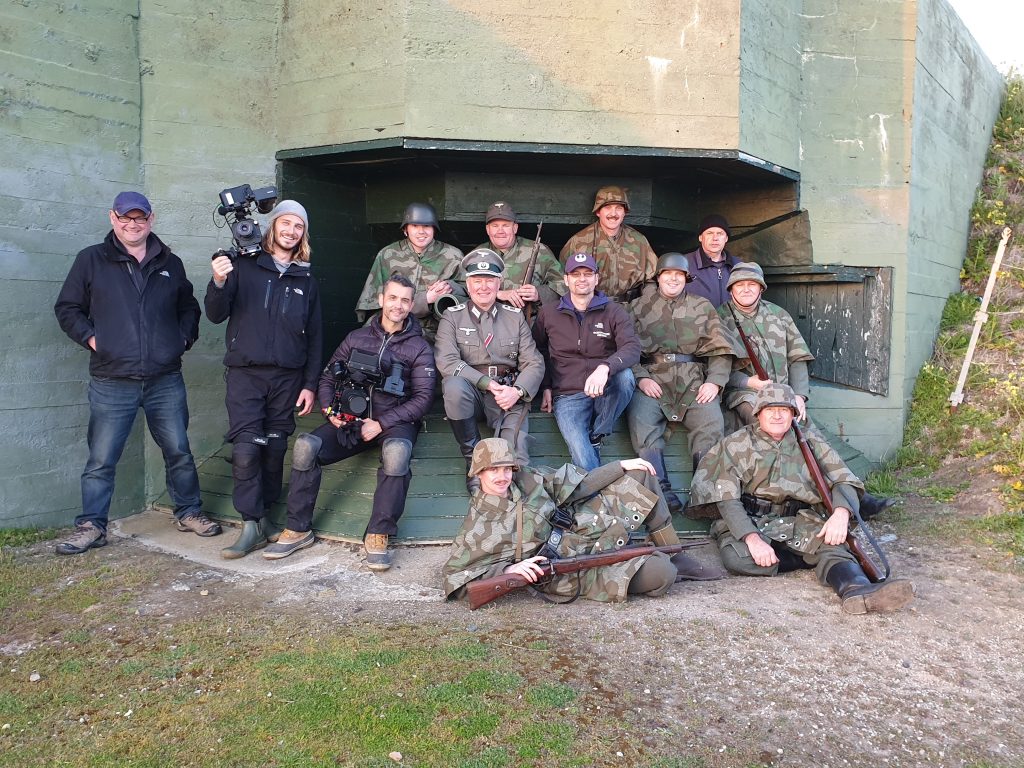
    Executive producer Daniel Oron said when they started researching subjects for their series, Guernsey came up quite quickly.

    ‘The imagery was so striking and the stories of the Occupation and fortification so compelling we knew we had to include it in our first season of Secret Nazi Bases,’ he said.

    ‘When we arrived in November 2018, the island exceeded our expectations. We couldn’t have asked for more from the locations and stories. We now know there is so much more than we could cover in a single dedicated episode of the series. The island’s heritage is so rich and that’s just considering the Occupation. We can’t wait to come back and film more in the future.’

    The Guernsey episode is set to air at 8pm on 8 November on Yesterday (UKTV).

    Read more the on Guernsey Press website

    Read more on the Visit Guernsey website
  • Exclusive: Science Channel searches for “Secret Nazi Ruins”

    Exclusive: Science Channel searches for “Secret Nazi Ruins”

    Discovery-owned Science Channel has set an early September debut for the investigative docuseries Secret Nazi Ruins from Toronto’s Go Button Media.

    The series will seek to dig up mysteries from some of the most covert of Adolf Hitler’s World War II projects, as experts dissect and reveal the purpose and technical design behind each shadowy structure – from tunnels to towers, artillery sites, resistance nests and communication centers.

    Among the various sites examined throughout Secret Nazi Ruins are the recently excavated Maisy Batteries, a large group of artillery batteries constructed by the Nazis; Dag Bromberg, a Polish base hidden in a forest; Bergkristal, a bunker and network of tunnels in the heart of Austria with mysterious levels of radiation; a peculiar mansion on a remote beach in the Canary Islands; and Kraftwerk Nord West in northern France, one of the largest Nazi bunkers ever constructed.

    Go Button’s Daniel Oron and Natasha Ryan are executive producers alongside Science Channel’s Neil Laird.

    Secret Nazi Ruins premieres Sept. 5 at 10 p.m. ET/PT on Science Channel.

    Read More on Realscreen.com

  • John Henry Phillips on BBC Suffolk (Audio)

    John Henry Phillips on BBC Suffolk (Audio)

    John Henry Phillips on the sofa with Lesley Dolphin for BBC Suffolk talking about the search for a lost D-Day shipwreck.

    “In the midst of all of the landings and the War, ships were dropping like flies, and so there wasn’t time to reflect and try to find out what happened. It was just forgotten about basically. With Patrick realizing that people do care about his story, and me asking him a few times, ‘Has anybody looked for your ship?’ and then realizing that there is no memorial for those men who died.” – John Henry Phillips

    Listen to the BBC interview below:

  • Eastbourne D-Day veteran’s chance to say a final farewell to lost friends

    Eastbourne D-Day veteran’s chance to say a final farewell to lost friends

    An Eastbourne veteran who was the last survivor of a sunken WW2 ship could soon have the chance to say a final goodbye to his lost comrades. The ship which Patrick Thomas, 93, barely escaped with his life from is being searched for after all these years thanks to his good friend John Henry Phillips. The process of finding the ship is now being made into a documentary called No Roses on a Sailor’s Grave.

    Patrick said, “The ship was my home and my shipmates my family. I remember them as 19-year-olds with our lives ahead of us but the wreck of our ship is now their grave. “I want the tragedy of that day to be remembered forever more. The making of this documentary has awakened old memories.”

    On D-Day the Royal Navy telegraphist boarded his ship in Portsmouth as thousands of soldiers prepared for a day that changed history. But on June 25, 1944, his ship was sunk by an acoustic mine, killing 35 of the 40 men on board. Knocked unconscious, 19-year-old Patrick awoke in the English Channel in time to see his friends and craft sink and vanish from history.

    Now Patrick believes he may be the only crew member left alive. Unsure exactly where the ship went down, he and the families of the crew have never had a place to honour the fallen. Only four of the dead were given a burial. But then, two years ago, military historian and conflict archaeologist John Phillips, 25, was offered a spare room by the veteran. After hearing Patrick’s story, John promised to locate the ship, document it, and install a permanent memorial on the coast.

    Undeterred by the gravity of his promise, his friend’s age, and the fact he can’t scuba dive, John set about the search during summer, piecing together official records and Patrick’s diaries and memories to narrow down the location of the ship. He said, “Every year we lose more of these heroes and with them goes vital history that can never be retold. This is one of the last chances for a project like this to be undertaken with one of the last of the greatest generation alongside for the journey.

    “I could find the wreck and build the memorial in ten years’ time but with Patrick here to see it, it means so much more. This is more than a shipwreck search. It is about commemoration, remembrance and a promise to a friend.”

    The whole process is being recorded for a documentary directed and produced by award-winning Canadian filmmakers. They’re hoping to raise around £35,000 to produce a full-length documentary called No Roses on a Sailor’s Grave.

    Read more at eastbourneherald.co.uk

  • BBC News: Archaeologist in search for ‘lost’ World War Two ship

    A friendship between an archaeologist and a Royal Navy veteran has led to an attempt to seek out the lost wreck of a ship that sank during World War Two.

    John Henry Philips, from Bury St Edmunds, Suffolk, met 93-year-old Patrick Thomas, from Eastbourne, while in Normandy.

    He has promised to find the landing craft, destroyed by a mine shortly after the D-Day landings and create a monument to honour Mr Thomas’ fallen shipmates, most of whom were killed in the explosion.

    Read more at BBC.com or watch the segment below!

  • PADI Interview: No Roses on a Sailor’s Grave

    PADI Interview: No Roses on a Sailor’s Grave

    We’re often told stories about how scuba diving has changed lives – from discovering a new hobby and set of friends to overcoming PTSD and finding peace from anxiety. These stories show to us what we already know; diving holds a special power over us, it’s healing and inspiring.

    There are many ways in which diving can play a role in healing and bringing peace, such as in the case of 94 year old WWII veteran Patrick Thomas and 26 year old conflict archaeologist John Henry Phillips. John has embarked upon a journey with filmmaker Daniel Oron from Go Button Media to document his journey to find the wreck of the ship Patrick was on in World War Two, which was sunk in the weeks after the Normandy Landings.

    We spoke to John and Daniel to find out more about this exciting project.

    How did this project, No Roses on a Sailor’s Grave, come about?

    John: As an archaeologist and war historian I travel to Normandy every year to visit the D-Day landing sites with veterans. One year due to a mix up I was left off the room plan so had no accommodation. Thankfully a 94 year old veteran, Patrick, had a spare room and we hit it off in a way I’ve never really experienced before and after spending the week together we stayed in contact. In June 2017 we headed back to the Normandy celebrations and I could see Patrick was visibly upset after visiting the Operation Neptune Museum – where there had been little to no mention of British involvement. I knew Patrick didn’t know exactly where his ship had sunk, along with most of his crewmates and friends, so I told him that someone should create a memorial for them and find his ship. And that it should be me.

    Daniel: We’ve been working with John on a number of TV projects when we found out about his promise to Patrick. His passion and approach to history made us equally excited and we knew the story was too good to let pass.

    Why is it so important to you both?

    John: Patrick is something special. I’ve learned the hard way – these guys don’t last forever so it’s hard to get too invested. But their stories are so compelling; meeting these guys is like meeting rockstars to me! I think finding this wreck represented 1000’s of the small stories. It’s really now or never. Patrick is the last survivor, and if he had passed before our journey had started then the ship and everyone who died on it would be forever forgotten.

    Daniel: Every year there are fewer and fewer veterans who can tell their story. First hand stories are critical; it’s a passing of knowledge. John is a young man helping tell a veteran’s story from over seven decades ago. But John has made much more than a promise to find his friend’s ship; he’s committed to train to dive so he can see the craft with his own eyes and bring closure to Patrick.

    Why go down the crowdfunding route?

    Daniel: We’re committed to telling this story one way or another. Crowd funding helps us make the film sooner so we can capture more moments of the journey with Patrick. It’s hard to find anyone in Europe, and specifically the UK who hasn’t been directly affected by this conflict so it’s a story we think will touch many.

    How has diving been able to help the project?

    John: I always knew I was going to have to learn to dive. As an archaeologist and war historian I’m so aware of sites underwater. This project gave me the incentive to get on it. Diving on this project will enable me to tell the story of Patrick’s wreck as an archaeologist, war historian, and friend.

    Daniel: John’s foray into diving wasn’t the most relaxing; he didn’t train in the crystal blue waters of the Philippines, but in the UK so he can dive in the cold and dark waters of Normandy. Right now, we’re pretty sure we know where the wreck is and without diving that would be the end of the journey – an image on sonar. But, because of the ability to dive the team can go down and really pay homage to it and see if first-hand for Patrick.

    John: It makes it so much more special having built this relationship with Patrick and his family. I’ll diving the wreck, knowing what it is, and for the last survivor. That’s why it was so necessary for me to learn to scuba dive.

    Daniel: Diving is the difference between seeing it behind a screen and really experiencing it; diving is enabling the resolution of the story.


    Been inspired to learn more about wreck diving? Check out the PADI wreck diver specialty.

    Read the full interview at padi.com