
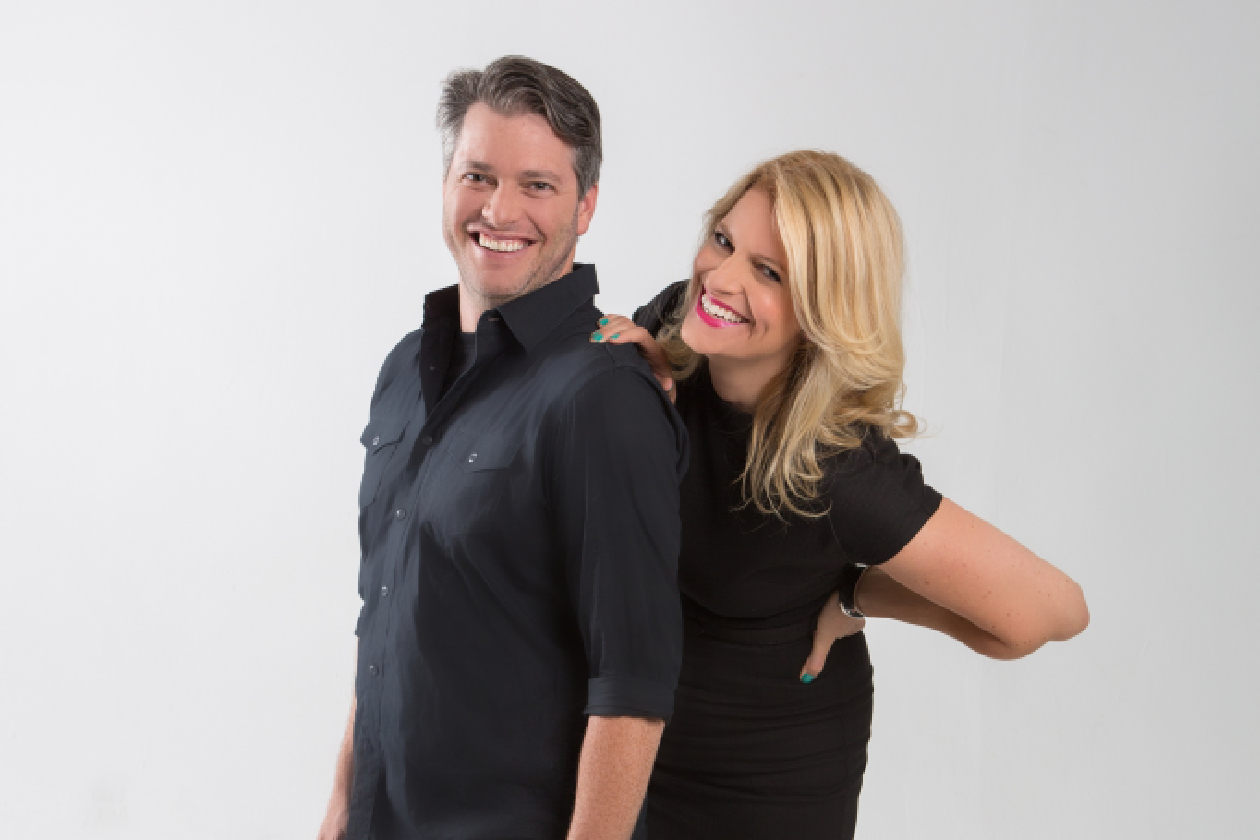
Toronto-headquartered unscripted production company Go Button Media is celebrating its 10th anniversary in 2025, having spent the past decade carving out a path for itself in an ever-changing television landscape.
Founded by Daniel Oron and Natasha Ryan (pictured above) in 2015, the company has built a reputation for reliably producing quality television across a range of genres — and budgets — with factual series spanning history (Revolutions That Changed History, Secret Nazi Bases) to science (Into the Universe) and engineering (Colossal Machines).
The company has also produced lifestyle content that covers everything from drag shows (Call Me Mother) to dating competitions (Mom vs. Matchmaker, pictured left) to baking (Bake and Make Up).
“It started as a desperation [move], and it turned into a business plan,” Oron tells Realscreen with a chuckle. “Go Button didn’t start with any intent, it was sort of an accident. Fifty shows later…”
Along the way, the pair — whose operation has grown to include more than two-dozen staff — have also built a solid network of networks and distributors that they collaborate with. It helps that when they launched Go Button, Oron and Ryan were both already experienced in various facets of TV production.
“Natasha and I came from so much making of TV, it wasn’t like a typical company where [it was formed by] an agent, a lawyer or an executive producer, or a former network executive,” Oron explains. “We’ve both been on the production side… I’ve been a cinematographer, a grip, a visual effects guy; Natasha was — in ancient history — a production manager, a writer, a director, a showrunner. So we had the confidence that if you tell me the show you want, I can give you a budget that is realistic.”
Building a global network of relationships
The company has, over the past decade, made diversity of content and potential buyers a priority, rather than locking into one or two big returnable series with a major U.S. network and putting most or all of their proverbial eggs into that basket.
“The North American way up until recently — I know it’s changed — was pretty siloed,” Oron says. “It was like, ‘Well, this is how the Smithsonian Channel works, this is how a Discovery Channel show works, this is how an HGTV show works.’ And I think, because we were sort of the little ones dodging in between all of them and connecting all the dots, we eventually learned so much.”
And now that accrued knowledge is giving them an edge as many other U.S. and Canadian prodcos are now attempting to shift their business to give it a more international focus, taking other markets into consideration in a way many of them previously hadn’t — something Go Button has been doing for years.
—
The secret sauce is, do the work. You’ve got to go out there and not rest on your laurels when you have one hit or one series.
—
“We work with ZDF, we work with Arte, we work with Hearst, we work with Polsat, we work with ProSieben, we work with Sky, Nat Geo,” he says. “I think it comes down to getting a little bit out of your own head as a North American company and being able to see [a] global perspective on shows.”
As Go Button continued to solidify its reputation as a reliable, go-to prodco for a number of network, streaming and distribution partners, funding their shows became less of an issue.
“It took time, but eventually we became a company that was known for having not just broadcasters, but distributors funding shows up front and fully, to the point where we were making slates of shows for distributors — and still do,” says Oron.
When it comes to building that web of contacts — networks, streamers, distributors and more — Oron insists there’s no secret sauce, and that he and Ryan and the Go Button team built the company the old-fashioned way: “Ten years of calling people and meeting people,” he says simply.
“The secret sauce is, do the work,” Oron explains. “You’ve got to literally go out there and not rest on your laurels when you have one hit or one series, or one franchise or [work in] one genre.”
A key relationship Go Button has cultivated is with the Canadian broadcaster Super Channel, which operates a suite of channels. The relationship began, Oron says, with a pickup of Go Button’s factual series, Phantom Signals, when the network’s then-chief content officer Jackie Pardy agreed to acquire the series on the spot during a meeting over coffee.
Go Button has since collaborated with Super Channel on more series, “and then we started working directly with Don [McDonald], the CEO, who has been just an unbelievable force for Go Button on so many levels,” Oron says. “Not just in terms of greenlighting shows and working with us on the marketing of them.”
Oron calls McDonald “a bit of a mentor and guide” on the business side as well. “It’s not like they have a financial stake in us; it’s just literally a wonderful relationship, and we hope and want it to continue forever,” he says. “They really believe in what we do and we’ve given them proof in terms of the content, and that’s actually spread to other channels in the world — SBS Australia, UKTV — where we have earned the trust that they don’t have to worry.”
“Our long‑standing relationship has evolved from single-series collaborations into a consistent stream of premium factual content, grounded in creativity, smart research, and strong production values,” McDonald told Realscreen, congratulating the prodco on “an incredible 10 years” and adding: “We look forward to continuing our collaboration and delivering more distinctive, high‑quality factual programming together.”
Incorporating AI into the mix
AI is of course one of the hot-button topics of the day for producers and buyers alike, and it’s one that Go Button is familiar with. Oron, who got his start in the screen industry with physical effects work before transitioning into computer-generated visual effects and eventually shifting into the realm of unscripted, has a bit of a unique perspective on the technology given his background, having worked in the VFX industry when CGI was taking hold. As a result, he’s found himself on several industry panels on AI at conferences all over the world.
“We view AI in lots of different lenses, because it really depends on what type of AI and what department is using it,” he says, breaking AI use into two separate silos, with chatbot and data aggregation on one side and generative AI on the other.
In the case of the former, Oron says the advantages it offers don’t affect creative work. “We see it as a really great tool to help us create closed-loop fact-checking and scripting, because if you train it and learn it… then it can really do a lot of the dirty work and the the hard labor that is not the creative [work] that we want to empower our writers, researchers, story editors to do.”
In terms of generative AI, Oron says the technology, when deployed properly, “democratizes storytelling a little bit” and allows unscripted prodcos and the talent they work with — writers, editors, producers, directors and cinematographers “to unleash their imagination on things that, prior to this, only scripted [prodcos] can do.”
By way of example, he mentions using GAI in pre-production. “You may not be able to put mood boards together the way an art director would for a scripted film. But if you’re doing a show about a new excavation in Pompeii — which we are — then there’s opportunities for you to communicate to a department in a visual way.”
Oron is also quick to note that the perception from a few years ago, when the tech was a shiny new toy and some executives were clearly salivating at the prospect of, say, hitting a key and immediately generating a screenplay for a blockbuster without having to pay a screenwriter, is misguided in a cost-conscious market.
“Doing really good AI has been the subject of the last few panels that we’ve been on,” he elaborates. “It actually costs a lot of money and takes a lot of time.”
And with the much-discussed democratization of content production and the idea that anyone can create content on their phones now, the skillful use of AI can give a company like Go Button an edge.
“In conjunction with AI, we’re able to do something that’s a lot bigger and more produced than someone could do alone with their phone,” says co-founder Natasha Ryan. “And while we have great respect and interest and enthusiasm for both types of filmmaking, we’ve been able to find something there that is specific to Go Button in a lot of ways.”
The next 10 years, and beyond
As for what’s next for Go Button, Oron is pragmatic. “I would say we’re going to go faster, we’re going to make more, we’re going to probably have to make it more affordable — all of us in the industry — and we’re also going to have to learn that the audience tells us [what works].”