Category: No Roses on a Sailor’s Grave

  • WWII veteran’s quest to find D-Day shipwreck and build a memorial to lost shipmates

    WWII veteran’s quest to find D-Day shipwreck and build a memorial to lost shipmates

    EXCLUSIVE: Seventy years after she was sunk off the French coast in the wake of D-Day, a chance encounter launched an extraordinary project to locate the wreck of a British ship… and commemorate those who went down with her.

    The 158-foot-long headquarters ship, one of thousands that set forth across the Channel, was part of the first wave heading for Sword Beach in Normandy.

    “I had certain qualms in my stomach, but you very quickly dismissed that because you’re busy,” Patrick Thomas, now 98, recalls.

    “When we arrived there initially, we didn’t get a very friendly welcome.

    “The Germans were rattling machine gun bullets on the hull. I saw the infantry running up the beach and sometimes they’d get shot and go down.”

    For the next two weeks, in the heat of battle, LCH185 played a key role in defending the landing beaches and saving survivors from other Allied vessels, which were taking a fearful pounding from relentless German attacks.

    Then, on June 25, Patrick’s world changed forever when LCH185 was hit by an acoustic mine. The veteran recollects that cataclysmic moment.

    “I didn’t hear the explosion, but it must have lifted the stern up and driven the bow under. The next thing I knew, we were underwater.”

    Read the full article on Express.co.uk.
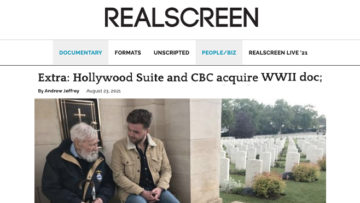
  • Extra: Hollywood Suite and CBC acquire WWII doc

    Extra: Hollywood Suite and CBC acquire WWII doc

    Hollywood Suite acquires No Roses on a Sailor’s Grave documentary

    Canadian broadcaster Hollywood Suite acquired the award-winning documentary No Roses on a Sailor’s Grave, production company Go Button Media announced on Monday (Aug. 23).

    CBC & Radio-Canada Distribution, meanwhile, took the worldwide rights, excluding Canada, for the documentary (pictured). The CBC will soon announce the film’s launch into the global market.

    The documentary tells the story of a lost World War II ship, and how a young archeologist and the last survivor of the wreck work together to recover the ship from forgotten history, more than 70 years later.

    The ship, LCH185, was part of the first wave on Sword Beach on D-Day. It helped protect the landing beaches from German attack for two weeks, until it was struck by an acoustic mine. LCH185 sank, taking all but a few surviving crew members with it. Patrick Thomas, a veteran telegraphist in the British Royal Navy who was on that ship, has lived with the memory ever since then.

    John Henry Phillips, a 25-year-old British archaeologist, promised Thomas that he will find the lost, wrecked ship and see that a memorial is built for its missing crew. The documentary film follows this work.

    “With only a small number of World War II veterans still among us, it is critical we help tell and record these stories before they move on from living memory,” said Daniel Oron of Go Button Media, and the director and executive producer of the film, in a news release.

    Sharon Stevens, vice president of programming at Hollywood Suite, added that the film mixes history and personal testimony, and that with time running out to hear WWII stories first hand, opportunities to see a film like this are becoming rarer.

    No Roses on a Sailor’s Grave was an official selection at several film festivals, and won Best Feature Documentary at the Sweden Film Awards, Best Narrative at the Amsterdam World International Film Festival, Best Director: Documentary at the Berlin Indie Film Festival and Angeles Documentaries Festival, as well as Best Feature Documentary at the Rome Independent Prisma Awards and Angeles Documentaries Festival.

    The feature documentary is scheduled for a worldwide TV premiere on Nov. 11 at 9 p.m. ET.

    Read the full article on Realscreen.

  • Award For Helping To Find A Lost D-Day Wreck

    Award For Helping To Find A Lost D-Day Wreck

    By Max James

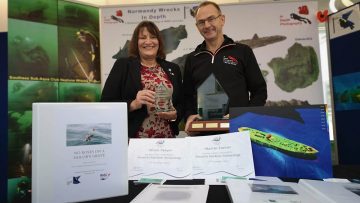
    A diving club’s help in finding the wreck of a ship lost during D-Day for one of the few who survived its sinking 75 years ago was rewarded with an award at the Nautical Archaeology Society (NAS) annual conference this month.

    Southsea Sub Aqua Club had joined the search for the ship that went down in 1944 with the loss of 35 of the 40-man crew. It started with the chance meeting of archaeologist John Henry Phillips, 25, and naval veteran Patrick Thomas, 95, during a D-Day commemoration. Patrick told John the story of how he had escaped but the ship had never been found and how he wished to honour his teenage friends who died in the sinking.

    The story of how John found the wreck and the friendship between the two has been made into a feature-length documentary called No Roses on a Sailor’s Grave.

    The role of Southsea Sub Aqua Club in helping to identify the wreck has honoured with the Adopt A Wreck Award at the NAS conference in Portsmouth.

    The club did extensive research into wrecks in the Baie de Seine and their detailed survey work is to be used in a bid to gain these rapidly decaying ships better protection.

    Alison Mayor from the club said: ‘The wreck is just one of at least 150 in the Baie de Seine believed to be associated with the Allied forces invasion. Our report has been submitted to the French Maritime Cultural Department and will form part of the documentation supporting the application for UNESCO World Heritage Site designation. We hope that our work will help keep the memory of these events alive and properly recorded within history’.

    Read the article on divemagazine.co.uk

  • Award-winning wreck-dives captured

    Award-winning wreck-dives captured

    Southsea Sub-Aqua Club members have won the Nautical Archaeology Society (NAS) 2019 Adopt a Wreck Award, and their search for a landing-craft sunk during the D-Day landings has been captured in a documentary called No Roses on a Sailor’s Grave.

    In 1944 young sailor Patrick Thomas narrowly survived the sinking of HMS LCH185 during the Normandy invasion. He had never spoken of the incident until, years later on a trip to Normndy, he met archaeologist John Henry Philips, who told him that he would to try to find LCH185.

    In August 2017 hydrographer Chris Howlett introduced Southsea SAC members to a documentary team from Go Button Media.

    “Chris believed he may have found Patrick’s wreck and recommended us as a dive-team who were capable of undertaking a survey of the wreck-site to confirm its identity,” said club-member Martin Davies.

    “When we heard about Patrick’s wish to commemorate his lost shipmates, we were very keen to support the endeavour so that he could honour his friends after more than 70 years, and support John in his promise to find his ship.”

    Most of the 7000 vessels involved in the Operation Neptune landings in June 1944 were lost, and many of those who died on them were never found. The divers surveyed the target wreck and created a report, as reflected in the documentary.

    “The wreck is just one of at least 150 wrecks in the Baie de Seine believed to be associated with the Allied forces invasion,” said the club’s Alison Mayor. “Our report has been submitted to the French Maritime Cultural Department and will form part of the documentation supporting the application for UNESCO World Heritage Site designation.

    “We hope that our work will help to keep the memory of these events alive and properly recorded within history.”

    For what the NAS describes as their “exceptional work” on the project, Mayor and Davies were awarded the Adopt a Wreck Award at the NAS Conference in Portsmouth.

    The feature-length documentary will be screened at film festivals from early 2020. “It’s rare you get a chance to change history, and in a small way we felt that following Patrick and John’s adventure achieves just that,” said director Daniel Oron.

    “Stories like these are important for current and future generations. Sadly, we lose more veterans each year and with so few still among us, the memories are fading and the world will move on. Yet events like those Patrick took part in are critical if we are to learn from history.”

    Read the article on diver.net

  • John Henry Phillips on BBC Suffolk (Audio)

    John Henry Phillips on BBC Suffolk (Audio)

    John Henry Phillips on the sofa with Lesley Dolphin for BBC Suffolk talking about the search for a lost D-Day shipwreck.

    “In the midst of all of the landings and the War, ships were dropping like flies, and so there wasn’t time to reflect and try to find out what happened. It was just forgotten about basically. With Patrick realizing that people do care about his story, and me asking him a few times, ‘Has anybody looked for your ship?’ and then realizing that there is no memorial for those men who died.” – John Henry Phillips

    Listen to the BBC interview below:

  • Diving into Film Making with Daniel Oron

    Diving into Film Making with Daniel Oron

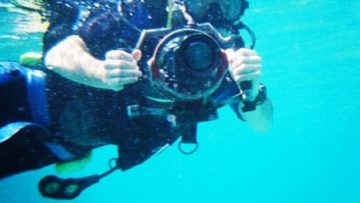
    Using scuba diving in your job isn’t just the reserve of dive professionals, the skills you learn can be translated to many other career paths. We spoke to Daniel Oron, of Go Button Media on how diving has impacted his career as a film maker and cinematographer.

    How did you get into diving?

    I began diving when I was living in Israel in the mid 90’s and became a fully certified PADI Open Water Diver in Mexico in the early 2000s.

    Was becoming a diver something you wanted to do to help your work?

    I always wanted to explore under water and diving was definitely going to be part of my life. I didn’t realize until later on in life how useful it would be to my career as well.

    How has your PADI training benefited you in your career in filmmaking?

    Once I became officially PADI certified it opened a whole new realm of possibilities for me. As a filmmaker and cinematographer I didn’t want to be limited in my access to the story and characters I was directing, in fiction or documentary. Having the benefit of great training and a diving system to work within helped me go places and tell stories I wouldn’t be able to otherwise.

    What’s a normal workday like for you?

    The best part of being a filmmaker and content creator is there is no ‘normal’ day. Every day is completely different with new challenges and new exciting opportunities  One day I’ll be in a stimulating creative brainstorm meeting with a broadcaster and the next we’ll be shooting life in the Arctic, a cheetah rescue in Africa or running an awesome team filming a killer new series.

    Can you tell us a bit about some projects where you’ve been able to combine your love of diving and storytelling?

    I’ve been fortunate enough to combine diving and my work many times, including one of our recent doc adventure series ‘discovering Routes’ in the Philippines where we went diving with sea cows, exploring ancient reefs and, filming whale sharks.  I’ve also had the pleasure of filming accessible scuba with a blind diver on a show called ‘Access Unlimited’. In the spring of 2018 we’ll be filming an underwater expedition for a lost World War II ship for a new documentary, No Roses on A Sailors Grave, we’re producing where the dive will be more technical and difficult but rewarding in its own way as we attempt to change history.


    Read the original interview at PADI.com